


I've known there was something wrong with High-Fructose Corn Syrup for a long time, and now here's more bad news:
A study has found that there is mercury in many food-derived product additives including High-Fructose Corn Syrup. Here is a human-readable document with the information about the study.
The press release begins, "Mercury was found in nearly 50 percent of tested samples of commercial high fructose corn syrup (HFCS), according to a new article published today in the scientific journal, Environmental Health. A separate study by the Institute for Agriculture and Trade Policy (IATP) detected mercury in nearly one-third of 55 popular brand name food and beverage products where HFCS is the first or second highest labeled ingredient-including products by Quaker, Hershey's, Kraft and Smucker's."
If you are not reading product labels for additives, start doing it. This stuff is pervasive! It's in everything, and sometimes it's the first ingredient (i.e. 2nd ingredient in most soda aside from carbonated water....) Dangerous (for more than just this reason....). We absolutely need to go back to basics -- or as close to basics as humanly possible.
And this mercury discovery is on top of all sorts of other implications for HFCS -- obesity, complications for our sugar metabolism, empty calories, etc. My nutrition teacher said there were two huge nutritionally devastating trends to keep an eye on: HFCS and Partially Hydrogenated oils -- keep them both out of your diet and you'll be much better off for it, he warned.
Showing posts with label environment. Show all posts
Showing posts with label environment. Show all posts
Thursday, January 29, 2009


Friday, May 2, 2008
Documentary about Monsanto's food-supply conspiracy
I try to believe in the inherent good of all people. It keeps me going. I try not to look at anyone as absolute evil. After this video, I'm having a very very hard time picturing these people as anything but evil. It's one thing to be greedy -- it's another thing to hold all of life as we know it in your hands as a control & monetary leveraging tool.
This French documentary/exposé is a full-length feature film intended for theaters, and aired March 11 on French TV. Now it's essentially an underground video, squished from major video feeds and stores.
The World According to Monsanto
The video takes us through the beginnings of the Monsanto conspiracy, following a French investigative reporters' footsteps through the web of lies and government favoritism shown to this chemical-producing mega-giant. She goes to the US, India, Canada, the UK, Paraguay, and Mexico in pursuit of the truth. If you go to the Monsanto website, you will see many lies.
One example of a lie where Monsanto was caught is labeling RoundUp herbicides as "biodegradable" -- but the fines don't matter. After years of advertising the product as biodegradable, everyone already believed it -- the fines for false or misleading advertising don't matter. Once you've sprayed with RoundUp -- an intensive defoliation chemical -- it won't go away any time soon. Combine this with genetically modified crops -- crops modified to resist RoundUp.... I thought they would be modifying crops for better taste or yields, the same reasons we cross breed...this is absolutely insidious.
Don't break out the popcorn yet... corn, canola, cotton, soy and wheat are the compromised crops, with more to come soon.
Personal Note: I am SO glad my diet plan is non-gmo soy. However, I need to throw out my Boca burgers. :(
The moral: Buy organic (until the USDA allows gmos sprayed with RoundUp to be labeled organic -- I'm sure it will happen some day), buy non-gmo, buy local, and try SPIN farming. Meanwhile, we have to figure out something much more powerful to do, but what do you do when a powerful company can turn your food supply off?
You can order a DVD or download a copy using the big red button. I recommend downloading.
Thursday, April 24, 2008
Toxic Household Quiz
If you're interested in the effect of toxins in the home, and what you can do about them, you probably want to try the Toxic Household Quiz to see how much you know about what we're doing to our bodies, our family and our planet.
The fact is that we need to change what we're doing. Toxic cleaning product companies started reaching out to consumers with mass advertising in the 1950s and we bought into it. Now nearly every home has products with chemicals that are not tested for human safety, especially 1-3 generations down the road. Now we're seeing the effects of these chemicals on our children & children's children, and watching the decline of human health in the U.S. and other so-called advanced nations. And with the expansion of modernization programs into third-world countries we are ensuring that those giant chemical companies will bring their toxic products into all countries, to their benefit and the global environment's expense.
If you're already ready to change what you're doing, see: The Price of Clean-- and just answer that one question in the quiz.
Namaste!
Saturday, February 16, 2008
How's the shampoo?
Mom said "If the hand wash is this good, I wonder how good their shampoo is!" or something to that effect, and I had tried samples of the shampoo. Now I own the shampoo, and used the first combo -- the smaller bottles are for occasional use to remove the residue of products from the hair and do a deep-conditioning.
My hair the next day feels great. Soft, healthy and clean. There's a scalp nutrient that comes separately. I didn't bother with the hairspray, I don't use hairspray often enough to warrant owning it.
My scalp had been itching, and I think I may have been developing an allergic reaction to the normal shampoo. Today, after 2 days of using the scalp nutrient, no itches, flaking, etc.
I'm trying out all types of products, having a lot of fun with it. I hope you're having fun too!
Monday, February 11, 2008
Another terrific product line...laundry care!
Ok, a second load of dishes, with a bowl with oatmeal from the day before glued to it, nested in the middle of other bowls to make double sure the dishwasher detergent is making a difference proves to me that I wasn't dreaming about the tiny hands at work in my dishwasher.
So on to laundry. I can't believe how little it takes to wash the laundry. I'm going to have to try the brightener again, but the liquid HE compatible detergent uses very little to wash a whole lot. Everything comes out smelling fantastic -- not heavily perfumed, just lightly scented. The reason I'm going to have to try the brightener again is that I didn't follow the instructions. :( I tried putting it in with the detergent in the compartment and it just caked on the bottom of the compartment, hardly putting any into my load of whites at all. Next time I'll dissolve it in water like the instructions say to. They certainly know best and I shouldn't second-guess them. I'm hoping that they'll erase my son's bad habit of wiping his hands and face on his shirts.
I also used the dryer sheets which I like because when you're done you're left with recyclable paper rather than some nasty man-made material you're not sure if it belongs in the garbage or in the toxic waste facility.
Clean clothes that smell great -- at 1 ounce of liquid detergent per load. An environmentalist's dream.
Saturday, February 2, 2008
The youngest bag lady!
I asked my partner to come to the grocery store with me, and he eventually gave in (muhahahah!), and on the way out the door he said we'd take his car because it was already clear of ice. Ok, no problem. Then I said "Oh, I have to get the bags out of my car!" He stops and looks at me funny. "Bags?" "Yeah, bags for the groceries."
At this point I'm a little puzzled by his reaction, he's looking a little incredulous, like he's indulging a weirdo at a funny farm. With a little shrug he's off to his car, and I fetch a bag -- full of bags -- and get into his car. I'm puzzling over what's so odd about bringing my own bags to the store.

Mind you I have one of the most eclectic collections of bags. I have many more bags, but here's a sample in a photo of the types of bags we're talking about -- the ones that were in my car on Saturday.
So we fill up a shopping cart with more things than we intended to buy, and at the register, I put 3 bags on the belt and start putting the groceries on the belt. The cashier nonchalantly takes the bags I offered and starts checking out groceries and filling the bags. It's a Redners, and they have a bag policy (2cents off for every bag you bring -- it's not much: it's the environment that matters). At this point, my partner is watching. When the guy is running out of bags, I hand him a few more. He uses one plastic bag for the yogurts (the ones with only a flimsy tin lid now that they've dropped the extra plastic one (yay!)) in case they leak. When he's done he tallies the bags in my cart, and refunds me. Never mind that the bags in my cart hold 2-3 times the number of groceries -- the point is still clear that we're saving something. Money, environment, whatever it takes to motivate people.
We leave with about 6 or 7 of MY bags full of groceries. We're putting them into the car, and finally it's all filtering in and digesting in my partner's brain. When we're unloading the car carrying 6 comfortable bags over our shoulders and in our hands, packed to the brim, instead of 15 flimsy plastic bags with tiny uncomfortable handles, half-filled because the stuff weighs too much for the bags to handle he finally gets it. By now he's muttering, "This is brilliant! I hate even touching the plastic bags. And they gave you a refund for them!" I'm not impressed about the $.12, but I chuckle knowingly.
I always loved to carry a backpack with me in the city. A notebook, a fiction book, pens, pencils, maybe a sweatshirt, and often an extra string bag. It always gave me a pleasurable feeling to tell merchants to skip the bag and toss something into the backpack. I've been doing it for years and years. That's how Europe works -- they don't do the whole massive plastic bag thing like the US. We think it's a major hassle to carry a bag around, but they fold up really small or the string bags easily stuff into a spare compartment of another bag. My bag-of-bags fits easily in my trunk, and is easy to grab the big bag's handle and run into the store.
I have string bags from food coops, a couple paper bags just because they're large and it's a shame to not reuse them a few times -- they also hold their shape really well for bread and other soft foods. I have a huge(!) shopping bag -- certainly a 3-4 bag capacity -- from Prisms Promotions, a local promotional products consultant. I have another smaller bag from the Sullivan (NY) County Chamber of Commerce that specifically talks about going green. A very large plastic bag (in case I purchase pillows or blankets -- craft store purchases, etc. fluffy light huge things or big boxes) from a wholesale liquidation outlet. I don't always remember to take my bags into stores, I'm trying to get better at it. If you add my collection of "gadgety bags" like messenger bags, waist pouches, briefcases, computer bags, etc. I really start to look like a bag lady. I even crocheted my own string bag, and create bags when I do craft projects. Just call me a bag lady!
Friday, February 1, 2008
Dishwasher concentrate powder is like a hundred tiny hands in the machine!

I'm not a big fan of electric dishwashers. Energy-star-water-conserving or not, if they don't clean the dishes, you have to hand-wash the dishes yourself.
We got a dishwasher when we moved in. My partner hates hand-washing the dishes. I don't like hand-washing dishes, but I like hand-washing them after wasting water and electricity in the dishwasher even more. So after 1-2 years of using the dishwasher it started to leave a film of icky white stuff on the dishes, especially the top of cups, and hardly cleaning the silverware. Nothing I wanted touching my or my children's food. So I end up hand-washing the dishes. Bummer.
My roommate, the anal one who does most of the cleaning and hand dish-washing, is of basically the same opinion I am. If you have to re-wash, pre-wash, soak, spit, rinse and shine by hand, why the heck are you using the electronic dishwasher in the first place?
My partner doggedly insists on using the dishwasher. Me and my roommate wash by hand. It's a neverending battle. He's probably right that the residue and water sitting in the machine does it no good, but running it just for the sake of running it isn't good either.
That experience was with typical bulk-store-bought Members' Mark (Sam's Club) detergent -- your results may vary, mine stank. I bought it figuring that at least if I had to buy evil chemical waste producing dishwashing detergent, I would buy it in bulk and save waste on the garbage end of the cycle. Does anyone want a nearly-full container of conventional powdered dishwashing detergent? I didn't think so.
I may have a complete change of heart about the electronic dish washer. You see, I got the terrific starter kit for the green household cleaning products (and blogged about said green cleaning kit), and it came with automatic dishwasher concentrate powder. My partner had the conventional stuff out ready to use it, but he didn't run the dishwasher last night. I thought to run it this morning, and looked at the detergent sitting on top of the dishwasher. No Way, I thought. I put that box of detergent away, and I ran the load of dishes with the new eco-friendly dishwasher powder. One scoop in each cup -- it's a small scoop -- 2 teaspoon scoop. So 4 teaspoons of concentrate went into the machine.

And nothing's wrong with the dishes. They're mostly dry, we air dry the dishes -- there's a couple drops of CLEAR water on the rim of the bowl.
They don't smell like a dirty swimming pool.
They shine.
There are no spots -- I'm not a spot hawk, so don't quote me on this one, but I don't see the streaks and spots I've been seeing from the conventional detergent.
Everything is clean.
Everything smells safe.
I'm amazed. It's like a hundred tiny fairies were at work in my dishwasher making everything perfect. I had to blog about it immediately and let you know. I'm tempted to wake said partner and roommate and rush them into the kitchen to show them. That's why I have to blog. :) They'd kill me.
I hate having to say it, but your results may vary. Maybe we didn't have oatmeal this week. I don't know, but I know this load of dishes came out exactly the way I want them to!
Wednesday, January 23, 2008
It's not REALLY clean if it makes your family sick
I guess I can say it until I'm blue in the face, but I'll say it again. We're intimately connected to our environment. Everything we put into our body, we are putting into our environment. Everything we put into our environment, we're putting into our body.
There's no way to escape this basic fact of nature.
It's true of toxic chemicals, from chemotherapy and household cleaning products (link to Household Products Database by the US National Institutes of Health) to the jet fuel used to get an airplane from one place to another. No matter how far away something is, it's in your environment -- indoor or outdoor -- and it will find you.
The flip side of this is that it doesn't matter who puts it into the environment. If industry does it, it still ends up in our bodies and homes. Neighbors. Friends, parents, children, government, someone on the other side of the planet. We are directly and indirectly responsible for each other's health and well-being.
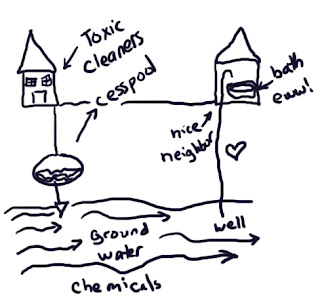
So, let's start with an easy example. You use toxic household cleaners, and you clean your house. You wash some tile and bathroom cleaner down the sink, toilet, tub drain. It ends up in your cesspool, septic tank, etc. It leaches into the ground, even though it goes through a filtration process and could theoretically biodegrade. These toxic cleansers are not biodegradable, so they leech into the ground, and into the groundwater.
Many of us drink from this groundwater. Or at the very least, we wash our bodies with it. Our skin is our largest organ, and it DOES absorb chemicals. We think of it as a barrier, but it's a barrier that will allow things in. The same chemicals from cleaners with huge warnings on their labels are now in our bathwater. Maybe we drink that water. Maybe we cook with it. It probably isn't the chemicals I put into the water that I wash with. It's probably the neighbor's chemicals. Or someone across town. Or someone in the mountains. The basic point is that it's now in my water supply.
If we can convince our neighbors to change to natural biodegradable cleaning fluids, this wouldn't happen, or, assuming we can't convert everyone, at the very least it would be possible to lessen the impact of these chemicals on our bodies.
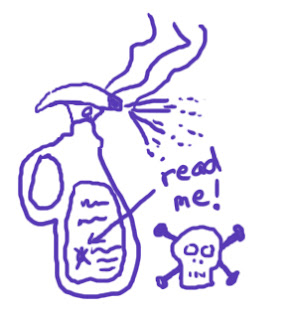
But what if we're cleaning with those chemicals. We may be poisoning our neighbors' groundwater, and we're certainly poisoning ourselves (link to a page by the National Organization for Women Foundation - stay at home moms & dads, and babies, beware!). Every spray, sprits, stream or the use of any product with fumes adds to the air pollutants in our homes. We breathe that air. Opening windows only helps a little, the fumes are there, we breathe them in, and it causes us to become sick -- either quickly, or a little at a time over a span of years.
What if we could change it? And still be clean and sanitary? Please join me in changing this. Once you've made the switch, tell your neighbors -- the life you may be saving could be your own. By purchasing environmentally-friendly, biodegradable, so safe you can let your baby and pets crawl on the floor, cleaning products you'll be making a change that makes sense (and cents, but I'll talk about packaging another time).
There's no way to escape this basic fact of nature.
It's true of toxic chemicals, from chemotherapy and household cleaning products (link to Household Products Database by the US National Institutes of Health) to the jet fuel used to get an airplane from one place to another. No matter how far away something is, it's in your environment -- indoor or outdoor -- and it will find you.
The flip side of this is that it doesn't matter who puts it into the environment. If industry does it, it still ends up in our bodies and homes. Neighbors. Friends, parents, children, government, someone on the other side of the planet. We are directly and indirectly responsible for each other's health and well-being.

So, let's start with an easy example. You use toxic household cleaners, and you clean your house. You wash some tile and bathroom cleaner down the sink, toilet, tub drain. It ends up in your cesspool, septic tank, etc. It leaches into the ground, even though it goes through a filtration process and could theoretically biodegrade. These toxic cleansers are not biodegradable, so they leech into the ground, and into the groundwater.
Many of us drink from this groundwater. Or at the very least, we wash our bodies with it. Our skin is our largest organ, and it DOES absorb chemicals. We think of it as a barrier, but it's a barrier that will allow things in. The same chemicals from cleaners with huge warnings on their labels are now in our bathwater. Maybe we drink that water. Maybe we cook with it. It probably isn't the chemicals I put into the water that I wash with. It's probably the neighbor's chemicals. Or someone across town. Or someone in the mountains. The basic point is that it's now in my water supply.
If we can convince our neighbors to change to natural biodegradable cleaning fluids, this wouldn't happen, or, assuming we can't convert everyone, at the very least it would be possible to lessen the impact of these chemicals on our bodies.

But what if we're cleaning with those chemicals. We may be poisoning our neighbors' groundwater, and we're certainly poisoning ourselves (link to a page by the National Organization for Women Foundation - stay at home moms & dads, and babies, beware!). Every spray, sprits, stream or the use of any product with fumes adds to the air pollutants in our homes. We breathe that air. Opening windows only helps a little, the fumes are there, we breathe them in, and it causes us to become sick -- either quickly, or a little at a time over a span of years.
What if we could change it? And still be clean and sanitary? Please join me in changing this. Once you've made the switch, tell your neighbors -- the life you may be saving could be your own. By purchasing environmentally-friendly, biodegradable, so safe you can let your baby and pets crawl on the floor, cleaning products you'll be making a change that makes sense (and cents, but I'll talk about packaging another time).
Subscribe to:
Posts (Atom)